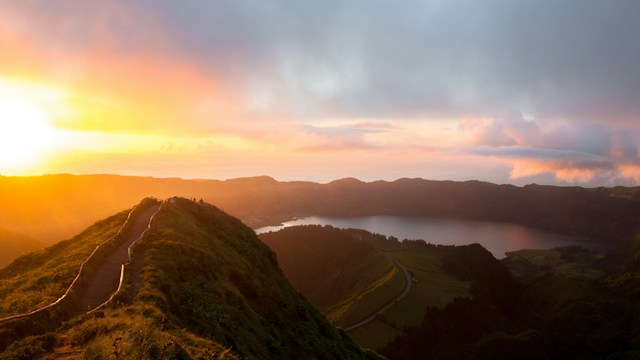
Volcanic peaks, crater lakes, black-sand beaches, whales offshore and hot springs in the jungle: that's Hawaii, and it's also the Azores. The difference is that this Portuguese archipelago sits in the mid-Atlantic, a few hours' flight from the UK, with no long-haul jet lag and Hawaii's crowds and prices nowhere to be seen.
The Azores are “nine volcanic islands in the Macaronesia region of the North Atlantic Ocean”, about 1,400 km west of mainland Portugal. They sit where three tectonic plates meet, and Wikipedia notes that, measured from the sea floor, “the Azores are among the tallest mountains on the planet.” Portugal's highest peak, Mount Pico, rises 2,351 m straight out of the ocean.
This guide compares the two archipelagos, shows which Azorean islands match which Hawaiian experiences, and covers flights, costs and the best time to go.
Azores vs Hawaii: how they compare
The Azores deliver most of Hawaii's volcanic drama for a fraction of the travel time and with about a seventh of the visitors.
| Azores | Hawaii | |
|---|---|---|
| Visitors (2025) | 1.4 million guests (SREA via Novidades) | 9.64 million (DBEDT via The Garden Island) |
| Inhabited islands | 9 | 8 main islands |
| Highest peak | Mount Pico, 2,351 m | Mauna Kea, 4,207 m |
| Travel time from London | About 4 hours direct, or about 2 hours from Lisbon or Porto | 17+ hours with at least one connection |
| Time difference | 1 hour behind the UK | 10–11 hours behind the UK |
| Typical daytime temperature | 16–25 °C | 24–31 °C (approx.) |
| Currency | Euro | US dollar |
| Signature experiences | Whale watching, hot springs, crater lakes, volcano hikes | Surfing, volcano parks, snorkelling, whale watching |
Where Hawaii wins: warm swimming seas and coral reefs. The Azores' sea is about 16 °C in late winter and 23 °C by late summer. Where the Azores win: cost, crowds and getting there. Hawaii's visitors spent a record US$273 each per day in 2025.
The islands: which one is your Maui?
Start with São Miguel, then add Pico and Faial; that trio covers volcanoes, whales and hot springs in one week. The nine islands fall into three groups spread over 600 km of ocean.
| Island | Group | Best for | Hawaiian equivalent |
|---|---|---|---|
| São Miguel | Eastern | Crater lakes, hot springs, tea, Ponta Delgada | Oʻahu: the main hub, with the most to do |
| Pico | Central | Climbing Mount Pico, UNESCO vineyards, whales | Hawaiʻi Island: the big volcano |
| Faial | Central | Capelinhos volcano, Horta marina, whales | Maui: sailing and whale-watching base |
| Terceira | Central | UNESCO-listed Angra do Heroísmo, festivals | — |
| São Jorge | Central | Cliff-edge fajãs, hiking, cheese | Molokaʻi: quiet and rugged |
| Flores | Western | Waterfalls and cliffs | Kauaʻi: the Garden Isle |
| Graciosa, Santa Maria, Corvo | Mixed | Slow travel; Santa Maria has the best beaches | Lānaʻi: small and calm |
São Miguel: the green island
São Miguel is the largest island (759 km²) and where most visitors land. The Sete Cidades caldera is 6 km by 5 km, holds twin lakes, and Wikipedia says its eruption record “makes it the most active in the archipelago.” In Furnas, “thirty springs, each of differing temperatures and chemical compositions” feed thermal pools including Terra Nostra Park. Locals cook cozido das Furnas, a meat-and-vegetable stew, using the volcanic heat. The north coast has Gorreana and Porto Formoso, two of Europe's very few working tea plantations.
Pico: Portugal's highest mountain
Mount Pico is “the highest mountain in Portugal, at 2,351 metres”, and Wikipedia notes it is “more than twice the elevation of any other peak in the Azores.” Below it lie the black lava-stone vineyards of the Landscape of the Pico Island Vineyard Culture, inscribed by UNESCO in 2004. UNESCO calls it:
“an outstanding example of the adaptation of farming practices to a remote and challenging environment.”
Faial: the blue island
Faial is a 30-minute ferry from Pico. Its Capelinhos volcano erupted offshore in 1957, adding new land to the island; the visitor centre is built into the ash. Horta's marina is a classic Atlantic sailing stopover, where crews paint their boats' names on the harbour wall.
Terceira: history and festivals
Terceira's capital, Angra do Heroísmo, was UNESCO-listed in 1983. UNESCO describes it as “an obligatory port of call from the 15th century until the advent of the steamship”.
Flores: the wild west
Flores is the westernmost island and the closest thing to Kauaʻi: sheer green cliffs streaked with waterfalls. It is small and quiet, and flights are weather-dependent, so leave a buffer day.
Five Hawaii-style experiences in the Azores
1. Whale and dolphin watching
The official tourism board, Visit Azores, calls the islands “one of the world's largest whale sanctuaries” and says “more than 20 different types of cetaceans can be spotted”, around a third of all known species. It adds that off Faial:
“The blue whale can be seen here, practically all year round, just a few miles off the coast.”
Book from Ponta Delgada, Horta or Lajes do Pico with an operator that follows the regional code of conduct.
2. Hot springs
Hawaii has volcanic heat; the Azores let you bathe in it. On São Miguel, try Terra Nostra Park and Poça da Dona Beija in Furnas, or the river pools at Caldeira Velha. On the coast at Ponta da Ferraria, hot water mixes with the Atlantic in a rock pool at low tide.
3. Volcano hikes
The Mount Pico climb is the headline: a long, steep day hike to Portugal's summit. Walkers must register at the mountain house before setting out. Easier options include the rim of Sete Cidades and the walk to Lagoa do Fogo on São Miguel.
4. Tea and volcanic food
Tour Gorreana's factory for free and walk the tea rows above the sea. In Furnas, order cozido das Furnas, a stew cooked in pots buried in the hot ground at the lakeside fumaroles, ideally at lunchtime when the pots come up. Wash it down with Pico's mineral-tasting verdelho wine.
5. Black-sand beaches and surfing
Santa Bárbara beach on São Miguel's north coast is the islands' surf hub, with black volcanic sand that will feel familiar to anyone who has seen Hawaiʻi Island's Punaluʻu. Bring a wetsuit; the Atlantic isn't the Pacific.
Getting there from the UK
Direct flights from the UK are now limited, so most British travellers connect through Lisbon or Porto. According to Azores Getaways (September 2026), “Ryanair discontinued all its Azores routes in March 2026”, taking away the cheap direct flights from several UK airports.
| Route | Airline | Flight time | Notes |
|---|---|---|---|
| London Heathrow → Ponta Delgada | British Airways | About 4 hours | Seasonal, roughly weekly |
| London Gatwick → Ponta Delgada | Azores Airlines | About 4 hours | Has run seasonally in past summers; check current schedules |
| Lisbon or Porto → Ponta Delgada | TAP, Azores Airlines | About 2 hours | Year-round, several daily; easy to pair with a city break |
Azores Airlines' StopOver programme lets you break a transatlantic trip in the Azores for up to seven days.
Getting between the islands
- Flights: SATA Air Açores links all nine islands; São Miguel to Pico or Faial takes under an hour.
- Ferries: Atlânticoline runs year-round ferries across the central “triangle” of Pico, Faial and São Jorge; Pico to Faial takes about 30 minutes.
- Car hire: Essential on São Miguel and Pico, and cheap outside July and August. Book early for summer.
A one-week itinerary
- Days 1–2: Ponta Delgada and Sete Cidades; hot springs at Ponta da Ferraria.
- Day 3: Furnas: cozido lunch, Terra Nostra Park, Gorreana tea estate.
- Day 4: Morning whale watch, then fly to Pico.
- Day 5: Climb Mount Pico, or walk the UNESCO vineyards and wine cellars.
- Day 6: Ferry to Faial: Capelinhos volcano and Horta marina.
- Day 7: Fly home via Ponta Delgada or Lisbon.
Practicalities: weather, costs and travelling well
When to go
May to September is the best window: the warmest, driest months and the most ferries and flights. Wikipedia notes that “daytime temperatures normally fluctuate between 16 and 25 °C”, and that temperatures above 30 °C or below 3 °C are “unknown in the major population centres.” The trade-off is that the weather is “generally wet and cloudy”, and it can change hourly. Pack layers and check crater-lake webcams before driving up.
Tourist tax
São Miguel's six municipalities charge a tourist tax of “two euros per night (up to a maximum of three nights)”, collected by your accommodation. Azores residents and people travelling for health reasons are exempt (The Portugal News). Alexandre Gaudencio, president of the Azores municipalities' association, told the paper:
“[The tax] should be charged to those who visit us and never to those who live here.”
A sustainable destination
According to Visit Azores, the Azores were “the first archipelago in the world to win the seal ‘Sustainable Tourism Destination’” under the EarthCheck programme, and renewed the certification in 2024. Help keep it that way:
- Stay on marked trails; many cross farmland and fragile crater rims.
- Choose whale-watching operators that keep to the regional code of conduct.
- Eat locally: Azorean beef, cheese from São Jorge, pineapples from São Miguel greenhouses.
- Visit outside July and August, when roads and viewpoints on São Miguel are busiest.
Is it busy?
Tourism is growing, but from a low base. The islands recorded 4,509,613 overnight stays in 2025, a fourth consecutive record and up 4.5% on 2024 (SREA via Novidades). Beyond São Miguel's best-known viewpoints, you will often have trails to yourself.
Money and health
The Azores are part of Portugal and the EU, so bring euros and a GHIC (Global Health Insurance Card), plus travel insurance that covers hiking. Check the FCDO's Portugal advice before you travel.
FAQ
Are the Azores like Hawaii?
In landscape, yes: both are volcanic island chains with crater lakes, hot springs, black-sand beaches and whale watching. The Azores are cooler, greener and far less crowded, with 1.4 million guests in 2025 against Hawaii's 9.64 million.
How long is the flight from the UK to the Azores?
About 4 hours direct from London to Ponta Delgada, or about 2 hours from Lisbon or Porto if you connect.
Which Azores island is best for a first visit?
São Miguel. It has the most flights, Sete Cidades, the Furnas hot springs and whale watching. Add Pico and Faial if you have a week.
Can you swim in the Azores?
Yes, in thermal pools year-round, and in the sea from June to October, when it reaches about 23 °C.
Is there a tourist tax in the Azores?
Yes, on São Miguel: €2 per person per night for up to three nights, collected by your accommodation.
What is the best time to visit the Azores?
May to September for the warmest, most settled weather. Blue whales can be seen off Faial almost all year.
Sources
- Wikipedia: Azores
- Wikipedia: Mount Pico
- Wikipedia: Furnas
- Wikipedia: Sete Cidades Massif
- UNESCO: Landscape of the Pico Island Vineyard Culture
- UNESCO: Central Zone of the Town of Angra do Heroísmo
- Visit Azores: whale watching
- Visit Azores: sustainable tourism destination
- Novidades / SREA: Azores tourism 2025
- The Garden Island: Hawaii visitor arrivals 2025
- The Portugal News: Azores tourist tax
- Azores Getaways: how to get to São Miguel
- Azores Airlines: London route