Max Letek — Travel Writer, Lost Land Travels Thursday 2 July 2026
Ask a room full of seasoned travellers to name the world's most misunderstood destination and, sooner or later, someone will say Iraq. The word alone conjures two decades of grim news footage. Yet in the tea houses of Erbil's bazaar, beneath a citadel that has been continuously inhabited for perhaps 6,000 years, a different Iraq has been quietly receiving visitors for years - one of glacier-fed mountain valleys, Ottoman-era souks and a hospitality culture that borders on the overwhelming.
So is Iraq now safe to travel? The honest answer, in the summer of 2026, is: parts of it, sometimes, for some travellers - and officially, not quite yet.
What the Foreign Office actually says
The official picture shifted meaningfully in June. In its latest update, the Foreign, Commonwealth and Development Office (FCDO) stepped back from the blanket "advise against all travel" warning it had imposed on the whole country earlier this year, when regional hostilities between Iran, Israel and the United States spilled dangerously close to Iraqi airspace and airports.
The current advice, updated on 19 June 2026, is layered. The FCDO advises against all travel to a list of Federal Iraq's most volatile areas - including Kirkuk, Ninawa, Salah al-Din and most of Diyala and western Anbar provinces, along with Sadr City in Baghdad and a 5km strip along the Iranian border. For everywhere else - and this is the part that matters to would-be tourists - it advises against all but essential travel. That includes Baghdad, Basra, the shrine cities of Karbala and Najaf, and, crucially, the entire Kurdistan Region of Iraq, Erbil included.
That last point surprises many. Kurdistan has long been treated as the "safe" Iraq - and in relative terms, it is. But Iranian strikes on Iranian-Kurdish opposition camps inside the region, Turkish military operations in the northern mountains, and the residual risk of attacks mean the FCDO is not yet prepared to give it a green light. The advice notes that a ceasefire has held since 8 April, and that the US and Iran have signed a memorandum of understanding - but warns the situation "remains unpredictable" and that hostilities could resume at short notice. The UK embassy in Baghdad continues to operate, though some staff were temporarily withdrawn as a precaution earlier this year.
The practical sting in the tail: travel against FCDO advice will very likely invalidate a standard travel insurance policy. Anyone determined to go needs a specialist insurer that explicitly covers Iraq - a small and expensive club.
For comparison, the US State Department remains blunter still, keeping Iraq at its highest "Level 4: Do Not Travel" rating.
Erbil: the other Iraq
None of which quite squares with the experience on the ground in Erbil, the Kurdish capital, where budget flights land from Istanbul and the Gulf, four- and five-star hotels compete for business travellers, and visitors from dozens of countries can obtain a visa on arrival or a straightforward e-visa.
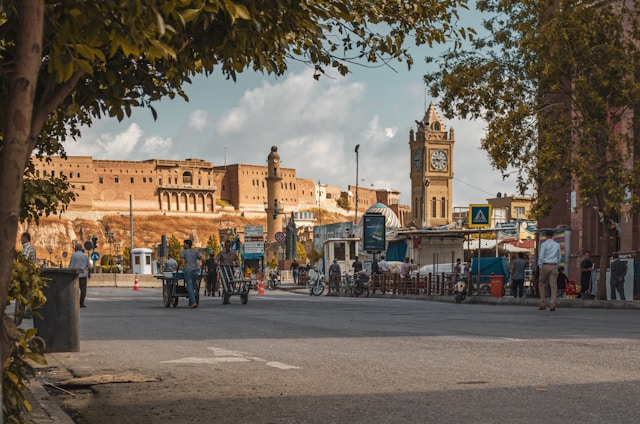
Erbil feels - and statistically has long been - closer to Amman than to the Iraq of the popular imagination. The centrepiece is the Unesco-listed citadel, a great earthen mound rising above the modern city, ringed by the Qaysari Bazaar where carpet sellers, honey merchants and gold traders have done business for centuries. In the evenings, families gather around the fountains of Shar Park below the citadel walls, and the tea flows until midnight.
Beyond the city, the Kurdistan Region opens into genuinely spectacular country: the gorges of Rawanduz, the waterfalls at Bekhal and Gali Ali Beg, the mountain town of Amedi perched improbably on its plateau, and the ancient Assyrian reliefs carved into the rock at Khinis. Sulaymaniyah, the region's cultural second city, offers museums, a lively café scene and a more liberal, bookish atmosphere. Checkpoints are frequent, professional and generally friendly; the Kurdish security services keep a tight grip, which is precisely why the region has been able to court tourism at all.
Federal Iraq: for the committed
South of Kurdistan, the calculation changes. Federal Iraq reopened to tourism in 2021 with a visa-on-arrival scheme for many nationalities, and a small but growing stream of independent travellers and tour groups has since made it to Baghdad's revitalised Mutanabbi Street book market, the ziggurat of Ur, the marshes of the south and the ruins of Babylon. Religious tourism to Najaf and Karbala, meanwhile, runs into the millions of pilgrims a year, and those cities maintain heavy security as a result.
Travellers who have made the journey tend to return evangelical about Iraqi hospitality — the strangers who insist on paying for your lunch, the families who invite you home from a shared taxi. But the risks the FCDO lists are not theoretical: unexploded ordnance in areas liberated from Islamic State, militia activity, kidnapping, and roads — including the highway between Baghdad and Erbil via Baqubah — that the government specifically advises against using. This is a destination for experienced travellers moving deliberately, ideally with reputable local operators, not for a casual week in the sun.
Lost Land Travel Verdict
Iraq in 2026 sits in an uncomfortable middle ground. It is unquestionably safer and more open than at almost any point in the past two decades, and the Kurdistan Region in particular offers a rich, rewarding and - day to day - largely calm travel experience. But this spring's regional escalation was a reminder of how quickly the weather can change, and for now the British government's formal position keeps even Erbil on the "essential travel only" list, with all the insurance consequences that follow.
Those who go anyway, and people do, in growing numbers - should do so with open eyes: specialist insurance, registered itineraries, trusted local contacts, and a close watch on the FCDO's Iraq page, which can change with little notice. Iraq rewards the well-prepared traveller extravagantly. It has little patience for the careless one.
Way to go
Getting there: There are no direct flights from the UK. Erbil International airport is served via Istanbul, Doha, Dubai and other regional hubs; Baghdad likewise. Flight schedules were disrupted during this year's regional tensions and remain subject to change at short notice.
Visas: The Kurdistan Region operates its own visa regime, with e-visas and visa-on-arrival available to many nationalities, including Britons. Federal Iraq issues a separate visa (around $165 for visa on arrival for eligible passports) — note that a Kurdish visa is not valid for travel into Federal Iraq.
Official advice: Check gov.uk/foreign-travel-advice/iraq before booking anything, and sign up for email alerts. As of June 2026, the FCDO advises against all travel to parts of Federal Iraq and against all but essential travel to the rest of the country, including the Kurdistan Region.
Insurance: Standard policies are invalidated by travel against FCDO advice. Specialist insurers offering Iraq cover include a handful of providers aimed at journalists, NGO workers and adventurous travellers — read the exclusions carefully.
When to go: Spring (March–May) and autumn (October–November). Summer temperatures in Baghdad and Basra routinely exceed 45C; the Kurdish mountains are cooler.