By Max Letek, Lost Land Travels · Last updated September 2026
Three cities, three separate UNESCO listings, and a high-speed train that connects them in a way almost no other Silk Road route in the world can match. Samarkand, Bukhara and Khiva were trading posts on the route between China and Europe for over a thousand years, and unlike most historic sites that get roped off into museum pieces, their old towns are still full of working bazaars, family-run guesthouses in restored merchant houses, and mosques that are still mosques. This is the itinerary that ties all three together properly.
Quick facts
Visa: UK citizens: completely visa-free for up to 30 days (Advantour)
Flights from UK: From around £207–£227 one-way, London to Tashkent
Currency: Uzbek Som (UZS); cards increasingly accepted, cash still useful outside hotels
Best time to visit: April–June and September–October
Minimum time needed: 7–8 days for all three cities plus Tashkent
Getting between cities: Afrosiyob high-speed train (Tashkent–Samarkand–Bukhara); separate train or road link on to Khiva
Why these three cities specifically
Each city holds its own UNESCO World Heritage listing, and each was inscribed for a different reason. Itchan Kala, Khiva's walled inner city, was Uzbekistan's first UNESCO site, listed in 1990 as an almost completely intact walled city. The Historic Centre of Bukhara followed in 1993, recognised for one of the best-preserved examples of a medieval Central Asian trading city. Samarkand - "Crossroads of Cultures" - was added in 2001, specifically for the scale and ambition of its Timurid-era monuments. Travelling all three back to back is essentially a tour through three different centuries of Central Asian architecture and power.
Samarkand: the showpiece
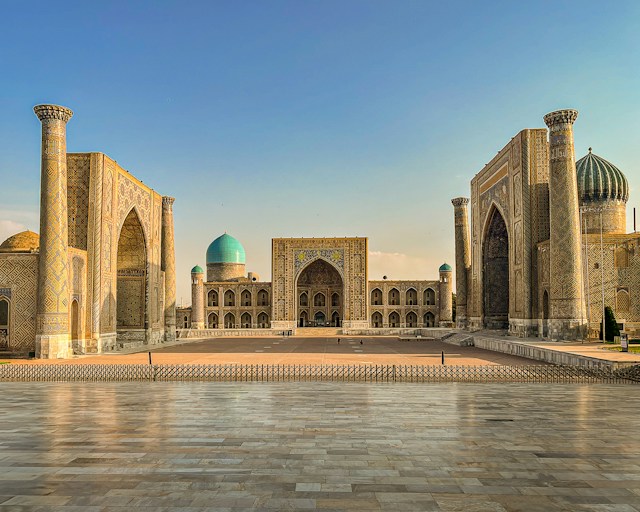
Give Samarkand two to three days. Registan Square is the reason most people book the trip in the first place - three monumental madrasahs facing each other across a single square, built between the 15th and 17th centuries. Entry is 100,000 UZS (roughly £6–8) for adults, and it's open from 7am to midnight, which matters: go at dawn for the empty square and soft light, then come back after dark when the facades are lit up. One traveller described standing in the middle of it as feeling "overwhelmed by the sheer scale of the structures and the intricate beauty that adorns them" and being "always awestruck no matter how often we returned" (What an Amazing World) - it's a site that rewards more than one visit if you have the time.
Beyond Registan, don't skip Gur-e-Amir, the mausoleum of Timur (Tamerlane), or Shah-i-Zinda, an avenue of turquoise-tiled tombs that's quieter than Registan but arguably just as striking. If you have a spare day, Shahrisabz - Timur's birthplace - makes a good half-day trip out of the city.
Bukhara: the living old town
Bukhara earns two to three days of its own, and it rewards slower travel more than Samarkand does - this is the city where you're meant to just wander. The Ark Fortress (60,000 UZS, roughly £4–5 entry, open 9am–6pm) was the residence of Bukhara's rulers for over a thousand years. The Poi Kalon ensemble, anchored by the 47-metre Kalyan Minaret, is the skyline landmark visible from most of the old town - Genghis Khan reportedly spared it from destruction because it impressed him too much to knock down.
Lyabi-Hauz, a 16th-century pool surrounded by mulberry trees, teahouses and madrasahs, is the natural place to end each day - it's one of the few Silk Road squares that still functions exactly as it was designed to, as a public gathering spot. Bukhara's old town is compact enough to cover mostly on foot, with day trips to countryside palaces like Sitorai Mokhi Khosa for those with an extra day.
Khiva: the walled city
Khiva is the smallest of the three and the most self-contained - the entire historic centre, Itchan Kala, sits inside a single set of mud-brick walls, and a single ticket (250,000 UZS, roughly £16–18 for adults) covers nearly everything inside, including the Kalta Minor minaret, Kuhna Ark fortress and Juma Mosque, with its forest of 200-plus carved wooden columns. Two days is enough; it's genuinely small enough to walk end to end in twenty minutes, though most people slow right down once they're inside the walls. Hiring a local guide here pays off more than in the other two cities - Khiva's history is denser and less signposted than Samarkand's or Bukhara's.
Getting there and between the cities
Fly into Tashkent from London for around £207–£227 one-way - there's no need to base yourself there beyond a day for the Chorsu Bazaar and the ornate Soviet-era metro stations, but it's the logistics hub for onward train tickets.
The Afrosiyob high-speed train covers Tashkent–Samarkand in 2.5 hours and Tashkent–Bukhara in around 5–6 hours, with economy fares from roughly 311,000 UZS (Samarkand) and 509,000 UZS (Bukhara) - about £19–£32 depending on route and class (Seat61). Khiva sits further west and isn't on the main Afrosiyob line: a direct train now runs Khiva–Bukhara since a new station opened in 2018, taking a comfortable route for $12–$20, or you can arrange a shared taxi via Urgench for $15–20 (6–8 hours) or a private taxi for around $50, which also lets you stop at Khorezm's desert fortresses en route (Backpack Adventures). Most itineraries run Tashkent → Khiva (by overnight train or short flight) → Bukhara → Samarkand → back to Tashkent, which avoids doubling back on yourself.
Book train tickets at least a week or two ahead through Uzbekistan Railways' English-language site (eticket.railway.uz) or via 12go.asia - Afrosiyob services do sell out, particularly in shoulder season.
Where to stay
All three cities have a strong run of boutique guesthouses inside restored 19th-century merchant houses, which is the accommodation style worth booking here over a generic hotel - you get carved wooden ceilings and courtyards for the price of a mid-range chain hotel elsewhere. Samarkand hotels start from around $23/night on Tripadvisor, with country-wide options from as little as $13/night on Kayak for more basic guesthouses. Book Bukhara and Khiva stays inside or right against the old town walls - being a short walk from the monuments matters more here than almost anywhere else, since so much of the experience is wandering after the day-trippers leave.
Best time to visit
April to June and September to October are the two windows worth planning around. Summer (July–August) regularly pushes past 40°C in the desert basin these cities sit in, which makes walking the old towns genuinely unpleasant by midday. Winter is workable and much quieter, but some sites keep shorter hours and it can drop below freezing at night, particularly in Bukhara and Khiva.
FAQs
How many days do you need for Samarkand, Bukhara and Khiva?
Seven to eight days minimum: 1–2 in Tashkent for logistics, 2 in Khiva, 2–3 in Bukhara, and 2–3 in Samarkand.
Do UK citizens need a visa for Uzbekistan?
No - Uzbekistan is completely visa-free for UK citizens for stays of up to 30 days.
What's the best way to travel between the cities?
The Afrosiyob high-speed train for Tashkent–Samarkand–Bukhara; a direct train, shared taxi, or private car on to Khiva, since it isn't on the main high-speed line.
Which city should you prioritise if you only have a few days?
Samarkand for the single most spectacular sight (Registan); Bukhara if you want a slower, more atmospheric old town to wander rather than a headline monument.
Is Uzbekistan safe to visit?
Yes - it's a well-established and increasingly popular tourist destination with a strong safety record; standard travel precautions apply.
What currency should you carry?
Uzbek Som. Cards are increasingly accepted in hotels and larger restaurants, but keep cash for bazaars, entry tickets and smaller guesthouses.